Package: inet.tutorials.queueing
RequestResponseTutorialStep
network(no description)
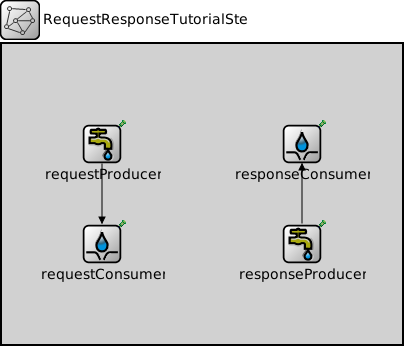
Usage diagram
The following diagram shows usage relationships between types. Unresolved types are missing from the diagram.
Properties
| Name | Value | Description |
|---|---|---|
| isNetwork | ||
| display | bgb=400,300 |
Unassigned submodule parameters
| Name | Type | Default value | Description |
|---|---|---|---|
| requestProducer.displayStringTextFormat | string | "created %p pk (%l)" |
Determines the text that is written on top of the submodule, supports displaying pars, watches, and module-specific information |
| requestProducer.packetNameFormat | string | "%a-%c" |
See directives in module documentation |
| requestProducer.packetRepresentation | string | "byteCount" |
Determines the chunk of the packet data |
| requestProducer.packetProtocol | string | "unknown" | |
| requestProducer.packetLength | int | ||
| requestProducer.packetData | int | -1 | |
| requestProducer.attachCreationTimeTag | bool | true | |
| requestProducer.attachIdentityTag | bool | true | |
| requestProducer.attachDirectionTag | bool | true | |
| requestProducer.clockModule | string | "" |
Relative path of a module that implements IClock(1,2); optional |
| requestProducer.initialProductionOffset | double | -1s |
Initial duration before which packets are not produced. When negative, then produce packet in initialize() |
| requestProducer.productionInterval | double |
Elapsed time between subsequent packets pushed to the connected packet consumer |
|
| requestProducer.scheduleForAbsoluteTime | bool | true |
When a clock is used, "relative" means that setting the clock will not affect the simulation time of the event |
| responseConsumer.displayStringTextFormat | string | "received %p pk (%l)" |
Determines the text that is written on top of the submodule, supports displaying pars, watches, and module-specific information |
| responseConsumer.clockModule | string | "" |
Relative path of a module that implements IClock(1,2); optional |
| responseConsumer.initialConsumptionOffset | double | 0s |
Initial duration before which packets are not consumed |
| responseConsumer.consumptionInterval | double | 0s |
Elapsed time between subsequent packets allowed to be pushed by the connected packet producer, 0 means any number of packets can be pushed at the same simulation time |
| responseConsumer.scheduleForAbsoluteTime | bool | true |
When a clock is used, "relative" means that setting the clock will not affect the simulation time of the event |
| responseProducer.provider.displayStringTextFormat | string | "created %p pk (%l)" |
Determines the text that is written on top of the submodule, supports displaying pars, watches, and module-specific information |
| responseProducer.provider.packetNameFormat | string | "%a-%c" |
See directives in module documentation |
| responseProducer.provider.packetRepresentation | string | "byteCount" |
Determines the chunk of the packet data |
| responseProducer.provider.packetProtocol | string | "unknown" | |
| responseProducer.provider.packetLength | int | ||
| responseProducer.provider.packetData | int | -1 | |
| responseProducer.provider.attachCreationTimeTag | bool | true | |
| responseProducer.provider.attachIdentityTag | bool | true | |
| responseProducer.provider.attachDirectionTag | bool | true | |
| responseProducer.provider.clockModule | string | "" |
Relative path of a module that implements IClock(1,2); optional |
| responseProducer.provider.initialProvidingOffset | double | 0s |
Initial duration before which packets are not provided |
| responseProducer.provider.providingInterval | double | 0s |
Elapsed time between subsequent packets allowed to be pulled by the connected packet collector, 0 means any number of packets can be pulled at the same simulation time |
| responseProducer.provider.scheduleForAbsoluteTime | bool | true |
When a clock is used, relative means that setting the clock will not affect the simulation time of the event |
| responseProducer.server.displayStringTextFormat | string | "contains %n tk\nserved %p pk (%l)" |
Determines the text that is written on top of the submodule, supports displaying pars, watches, and module-specific information |
| responseProducer.server.initialNumTokens | double | 0 |
Initial number of tokens |
| responseProducer.server.maxNumTokens | double | nan |
Maximum number of tokens |
| responseProducer.server.tokenConsumptionPerPacket | double | 1 |
How many tokens are consumed per processed packet |
| responseProducer.server.tokenConsumptionPerBit | double | 0 |
How many tokens are consumed per processed bit |
| responseProducer.multiplexer.displayStringTextFormat | string | "passed %p pk (%l)" |
Determines the text that is written on top of the submodule, supports displaying pars, watches, and module-specific information |
| responseProducer.multiplexer.forwardServiceRegistration | bool | true | |
| responseProducer.multiplexer.forwardProtocolRegistration | bool | true | |
| responseProducer.tokenGenerator.displayStringTextFormat | string | "generated %t tk\nto %s" |
Determines the text that is written on top of the submodule, supports displaying pars, watches, and module-specific information |
| responseProducer.tokenGenerator.storageModule | string | "^." + parent.requestConsumerModule + ".server" |
Module path of the token storage where the tokens are generated via C++ method call |
| responseProducer.tokenGenerator.subscriptionModule | string | "^" | |
| responseProducer.tokenGenerator.signals | string | "tokensDepleted" | |
| responseProducer.tokenGenerator.intSignalValue | int | -1 | |
| responseProducer.tokenGenerator.doubleSignalValue | double | nan | |
| responseProducer.tokenGenerator.numTokens | double | 1 |
Number of tokens generated repeatedly |
Source code
network RequestResponseTutorialStep
{
    @display("bgb=400,300");
    submodules:
        requestProducer: ActivePacketSource {
            @display("p=100,100");
        }
        responseConsumer: PassivePacketSink {
            @display("p=300,100");
        }
        requestConsumer: RequestConsumer {
            @display("p=100,200");
            responseProducerModule = "^.responseProducer";
        }
        responseProducer: ResponseProducer {
            @display("p=300,200");
            tokenGenerator.storageModule = "^.^.requestConsumer.server";
        }
    connections allowunconnected:
        requestProducer.out --> requestConsumer.in;
        responseProducer.out --> responseConsumer.in;
}

//-------------------------------------------------
File: tutorials/queueing/QueueingTutorial.ned
 This documentation is released under the Creative Commons license