Package: inet.emulation.networklayer.ipv4
ExtUpperIpv4NetworkLayer
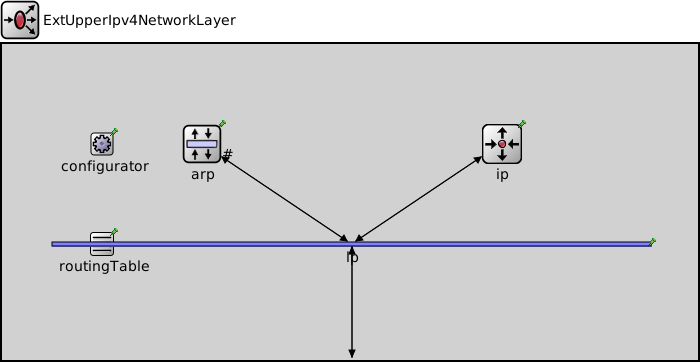
compound moduleProvides a network layer that connects the simulation to a real network on the host computer using a TUN device. Allows simulated applications to send and receive packets through the host's networking stack at the IP layer. Contains standard components like routing table and ARP, and uses ~ExtUpperIpv4 with a TUN device for external connectivity.
Using this network layer in a host or router implies that layers above IPv4 are provided by the host operating system, while layers below IPv4 are simulated.
Usage diagram
The following diagram shows usage relationships between types. Unresolved types are missing from the diagram.
Inheritance diagram
The following diagram shows inheritance relationships for this type. Unresolved types are missing from the diagram.
Parameters
| Name | Type | Default value | Description |
|---|---|---|---|
| interfaceTableModule | string |
Properties
| Name | Value | Description |
|---|---|---|
| display | i=block/fork |
Gates
| Name | Direction | Size | Description |
|---|---|---|---|
| ifIn | input | ||
| ifOut | output | ||
| transportIn | input | ||
| transportOut | output |
Unassigned submodule parameters
| Name | Type | Default value | Description |
|---|---|---|---|
| configurator.displayStringTextFormat | string | "" |
Determines the text that is written on top of the submodule, supports displaying pars, watches, and module-specific information |
| configurator.interfaceTableModule | string |
The path to the InterfaceTable module |
|
| configurator.routingTableModule | string | ||
| configurator.networkConfiguratorModule | string | "configurator" |
TODO eventually rename to networkConfigurator |
| configurator.configureRoutingTable | bool | true |
Add routing entries to the routing table (uses the configurator module) |
| routingTable.displayStringTextFormat | string | "" |
Determines the text that is written on top of the submodule, supports displaying pars, watches, and module-specific information |
| routingTable.interfaceTableModule | string |
The path to the InterfaceTable module |
|
| routingTable.routerId | string | "auto" |
For routers, the router id using IPv4 address dotted notation; specify "auto" to select the highest interface address; should be left empty ("") for hosts |
| routingTable.netmaskRoutes | string | "*" |
Maintain netmask routes for interfaces |
| routingTable.forwarding | bool | true |
Turns IP forwarding on/off |
| routingTable.multicastForwarding | bool | false |
Turns multicast forwarding on/off |
| routingTable.useAdminDist | bool | false |
Use Cisco-like administrative distances |
| routingTable.routingFile | string | "" |
Routing table file name |
| lp.displayStringTextFormat | string | "processed %p pk (%l)" |
Determines the text that is written on top of the submodule, supports displaying pars, watches, and module-specific information |
| lp.interfaceTableModule | string |
Module path to the ~InterfaceTable module |
|
| lp.forwardServiceRegistration | bool | true | |
| lp.forwardProtocolRegistration | bool | true | |
| lp.interfaceMapping | object | {} |
Maps network interface names to connected submodule names (e.g. {"eth0": "bridging"}), overrides automatically learned dispatching; * overrides all learned network interfaces, ? overrides default |
| lp.serviceMapping | object | {} |
Maps protocols to connected submodule names (e.g. {"ethernetmac": "bridging"}), overrides automatically learned dispatching; * overrides all learned services, ? overrides default |
| lp.protocolMapping | object | {} |
Maps protocols to connected submodule names (e.g. {"ipv4": "bridging"}), overrides automatically learned dispatching; * overrides all learned protocols, ? overrides default |
Source code
//
// Provides a network layer that connects the simulation to a real network on the
// host computer using a TUN device. Allows simulated applications to send and
// receive packets through the host's networking stack at the IP layer. Contains
// standard components like routing table and ARP, and uses ~ExtUpperIpv4 with a
// TUN device for external connectivity.
//
// Using this network layer in a host or router implies that layers above IPv4 are
// provided by the host operating system, while layers below IPv4 are simulated.
//
module ExtUpperIpv4NetworkLayer like INetworkLayer
{
    parameters:
        string interfaceTableModule;
        *.interfaceTableModule = default(absPath(this.interfaceTableModule));
        *.routingTableModule = default(absPath(".routingTable"));
        @display("i=block/fork");

    gates:
        input ifIn @labels(INetworkHeader);
        output ifOut @labels(INetworkHeader);
        input transportIn @labels(Ipv4ControlInfo/down);
        output transportOut @labels(Ipv4ControlInfo/up);

    submodules:
        configurator: Ipv4NodeConfigurator {
            parameters:
                @display("p=100,100;is=s");
        }
        routingTable: Ipv4RoutingTable {
            parameters:
                @display("p=100,200;is=s");
        }
        ip: <default("ExtUpperIpv4")> like IIpv4 {
            parameters:
                @display("p=500,100");
        }
        arp: <default("Arp")> like IArp {
            parameters:
                @display("p=200,100;q=pendingQueue");
        }
        lp: MessageDispatcher {
            parameters:
                @display("p=350,200;b=600,5");
        }

    connections allowunconnected:
        arp.ifOut --> lp.in++;
        arp.ifIn <-- lp.out++;

        ip.queueOut --> lp.in++;
        ip.queueIn <-- lp.out++;

        lp.out++ --> { @display("m=s"); } --> ifOut;
        lp.in++ <-- { @display("m=s"); } <-- ifIn;
}
File: src/inet/emulation/networklayer/ipv4/ExtUpperIpv4NetworkLayer.ned
 This documentation is released under the Creative Commons license