Package: inet.tutorials.queueing
ExampleCompoundPriorityQueue
compound module(no description)
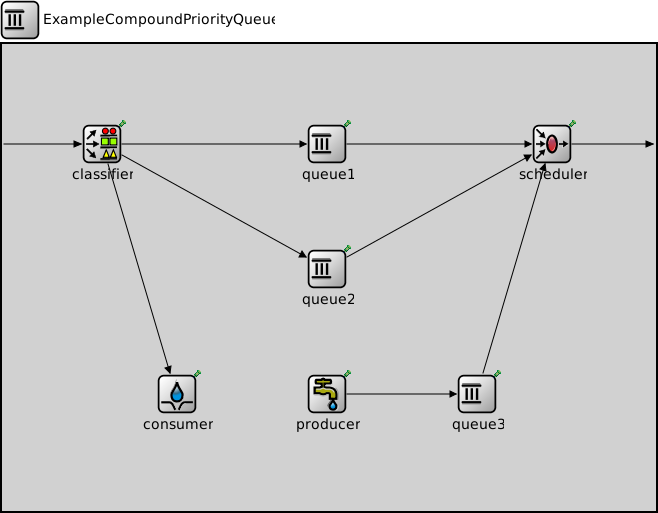
Usage diagram
The following diagram shows usage relationships between types. Unresolved types are missing from the diagram.
Inheritance diagram
The following diagram shows inheritance relationships for this type. Unresolved types are missing from the diagram.
Used in
| Name | Type | Description |
|---|---|---|
| CompoundPacketQueueTutorialStep | network | (no description) |
Extends
| Name | Type | Description |
|---|---|---|
| CompoundPacketQueueBase | compound module |
This compound module serves as a base module for complex packet queues formed by combining several queueing components. |
Parameters
| Name | Type | Default value | Description |
|---|---|---|---|
| displayStringTextFormat | string | "contains %p pk (%l) pushed %u created %c\n pulled %o removed %r dropped %d" |
Determines the text that is written on top of the submodule, supports displaying pars, watches, and module-specific information |
| packetCapacity | int | -1 |
Maximum number of packets in the queue, no limit by default |
| dataCapacity | int | -1b |
Maximum total length of packets in the queue, no limit by default |
| dropperClass | string | "" |
Determines which packets are dropped when the queue is overloaded, packets are not dropped by default; the parameter must be the name of a C++ class which implements the IPacketDropperFunction C++ interface and is registered via Register_Class |
Properties
| Name | Value | Description |
|---|---|---|
| class | ::inet::queueing::CompoundPacketQueueBase | |
| display | i=block/queue | |
| defaultStatistic | queueLength:vector |
Gates
| Name | Direction | Size | Description |
|---|---|---|---|
| in | input | ||
| out | output |
Signals
| Name | Type | Unit | Description |
|---|---|---|---|
| packetRemoved | inet::Packet | ||
| packetPushStarted | inet::Packet | ||
| packetDropped | inet::Packet | ||
| packetPushEnded | inet::Packet? | ||
| packetPulled | inet::Packet |
Statistics
| Name | Title | Source | Record | Unit | Interpolation Mode | Description |
|---|---|---|---|---|---|---|
| queueBitLength | queue bit length | warmup(atomic(constant0(localSignal(packetPushEnded)) + sum(packetLength(localSignal(packetPushStarted))) - sum(packetLength(localSignal(packetPulled))) - sum(packetLength(localSignal(packetRemoved))) - sum(packetLength(localSignal(packetDropped))))) | last, max, timeavg, vector | b | sample-hold |
the statistical value is the total bit length of all packets in the queue |
| queueLength | queue length | warmup(atomic(constant0(localSignal(packetPushEnded)) + count(localSignal(packetPushStarted)) - count(localSignal(packetPulled)) - count(localSignal(packetRemoved)) - count(localSignal(packetDropped)))) | last, max, timeavg, vector | pk | sample-hold |
the statistical value is the number of packets in the queue |
| droppedPacketsQueueOverflow | dropped packets: queue overflow | packetDropReasonIsQueueOverflow(localSignal(packetDropped)) | count | pk | none |
the statistical value is the packet that is dropped due to queue overflow |
| queueingTime | queueing times | queueingTime(localSignal(packetPulled)) | histogram, vector | s | none |
the statistical value is the queueing time of packets |
| incomingDataRate | incoming datarate | throughput(localSignal(packetPushStarted)) | vector | bps | linear |
the statistical value is the data rate of the incoming packets |
| flowQueueingTime | flow queueing times | queueingTime(demuxFlow(localSignal(packetPulled))) | histogram, vector | s | none |
the statistical value is the flow specific queueing time of packets |
| incomingPacketLengths | incoming packet lengths | packetLength(localSignal(packetPushStarted)) | sum, histogram, vector | b | none |
the statistical value is the length of the incoming packet |
| flowIncomingDataRate | flow specific incoming data rate | throughput(flowPacketLength(demuxFlow(localSignal(packetPushStarted)))) | vector | bps | linear |
the statistical value is the flow specific data rate of the incoming packets |
| outgoingDataRate | outgoing datarate | throughput(localSignal(packetPulled)) | vector | bps | linear |
the statistical value is the data rate of the outgoing packets |
| outgoingPacketLengths | outgoing packet lengths | packetLength(localSignal(packetPulled)) | sum, histogram, vector | b | none |
the statistical value is the length of the outgoing packet |
| droppedPacketLengthsQueueOverflow | dropped packet lengths: queue overflow | packetLength(packetDropReasonIsQueueOverflow(localSignal(packetDropped))) | sum, vector | b | none |
the statistical value is the length of the packet that is dropped due to queue overflow |
| flowOutgoingDataRate | flow specific outgoing data rate | throughput(flowPacketLength(demuxFlow(localSignal(packetPulled)))) | vector | bps | linear |
the statistical value is the flow specific data rate of the outgoing packets |
| incomingPackets | incoming packets | localSignal(packetPushStarted) | count | pk |
the statistical value is the incoming packet |
|
| outgoingPackets | outgoing packets | localSignal(packetPulled) | count | pk |
the statistical value is the outgoing packet |
Unassigned submodule parameters
| Name | Type | Default value | Description |
|---|---|---|---|
| classifier.displayStringTextFormat | string | "classified %p pk (%l)" |
Determines the text that is written on top of the submodule, supports displaying pars, watches, and module-specific information |
| classifier.reverseOrder | bool | false | |
| classifier.weights | string | ||
| queue1.displayStringTextFormat | string | "contains %p pk (%l) pushed %u\npulled %o removed %r dropped %d" |
Determines the text that is written on top of the submodule, supports displaying pars, watches, and module-specific information |
| queue1.packetCapacity | int | -1 |
Maximum number of packets in the queue, no limit by default |
| queue1.dataCapacity | int | -1b |
Maximum total length of packets in the queue, no limit by default |
| queue1.dropperClass | string | "" |
Determines which packets are dropped when the queue is overloaded, packets are not dropped by default; the parameter must be the name of a C++ class which implements the IPacketDropperFunction C++ interface and is registered via Register_Class |
| queue1.comparatorClass | string | "" |
Determines the order of packets in the queue, insertion order by default; the parameter must be the name of a C++ class which implements the IPacketComparatorFunction C++ interface and is registered via Register_Class |
| queue1.bufferModule | string | "" |
Relative module path to the IPacketBuffer module used by this queue, implicit buffer by default |
| queue2.displayStringTextFormat | string | "contains %p pk (%l) pushed %u\npulled %o removed %r dropped %d" |
Determines the text that is written on top of the submodule, supports displaying pars, watches, and module-specific information |
| queue2.packetCapacity | int | -1 |
Maximum number of packets in the queue, no limit by default |
| queue2.dataCapacity | int | -1b |
Maximum total length of packets in the queue, no limit by default |
| queue2.dropperClass | string | "" |
Determines which packets are dropped when the queue is overloaded, packets are not dropped by default; the parameter must be the name of a C++ class which implements the IPacketDropperFunction C++ interface and is registered via Register_Class |
| queue2.comparatorClass | string | "" |
Determines the order of packets in the queue, insertion order by default; the parameter must be the name of a C++ class which implements the IPacketComparatorFunction C++ interface and is registered via Register_Class |
| queue2.bufferModule | string | "" |
Relative module path to the IPacketBuffer module used by this queue, implicit buffer by default |
| queue3.displayStringTextFormat | string | "contains %p pk (%l) pushed %u\npulled %o removed %r dropped %d" |
Determines the text that is written on top of the submodule, supports displaying pars, watches, and module-specific information |
| queue3.packetCapacity | int | -1 |
Maximum number of packets in the queue, no limit by default |
| queue3.dataCapacity | int | -1b |
Maximum total length of packets in the queue, no limit by default |
| queue3.dropperClass | string | "" |
Determines which packets are dropped when the queue is overloaded, packets are not dropped by default; the parameter must be the name of a C++ class which implements the IPacketDropperFunction C++ interface and is registered via Register_Class |
| queue3.comparatorClass | string | "" |
Determines the order of packets in the queue, insertion order by default; the parameter must be the name of a C++ class which implements the IPacketComparatorFunction C++ interface and is registered via Register_Class |
| queue3.bufferModule | string | "" |
Relative module path to the IPacketBuffer module used by this queue, implicit buffer by default |
| consumer.displayStringTextFormat | string | "received %p pk (%l)" |
Determines the text that is written on top of the submodule, supports displaying pars, watches, and module-specific information |
| consumer.clockModule | string | "" |
Relative path of a module that implements IClock(1,2); optional |
| consumer.initialConsumptionOffset | double | 0s |
Initial duration before which packets are not consumed |
| consumer.consumptionInterval | double | 0s |
Elapsed time between subsequent packets allowed to be pushed by the connected packet producer, 0 means any number of packets can be pushed at the same simulation time |
| consumer.scheduleForAbsoluteTime | bool | true |
When a clock is used, "relative" means that setting the clock will not affect the simulation time of the event |
| producer.displayStringTextFormat | string | "created %p pk (%l)" |
Determines the text that is written on top of the submodule, supports displaying pars, watches, and module-specific information |
| producer.packetNameFormat | string | "%a-%c" |
See directives in module documentation |
| producer.packetRepresentation | string | "byteCount" |
Determines the chunk of the packet data |
| producer.packetProtocol | string | "unknown" | |
| producer.packetLength | int | ||
| producer.packetData | int | -1 | |
| producer.attachCreationTimeTag | bool | true | |
| producer.attachIdentityTag | bool | true | |
| producer.attachDirectionTag | bool | true | |
| producer.clockModule | string | "" |
Relative path of a module that implements IClock(1,2); optional |
| producer.initialProductionOffset | double | -1s |
Initial duration before which packets are not produced. When negative, then produce packet in initialize() |
| producer.productionInterval | double |
Elapsed time between subsequent packets pushed to the connected packet consumer |
|
| producer.scheduleForAbsoluteTime | bool | true |
When a clock is used, "relative" means that setting the clock will not affect the simulation time of the event |
| scheduler.displayStringTextFormat | string | "scheduled %p pk (%l)" |
Determines the text that is written on top of the submodule, supports displaying pars, watches, and module-specific information |
| scheduler.reverseOrder | bool | false |
Source code
module ExampleCompoundPriorityQueue extends CompoundPacketQueueBase
{
    parameters:
        @class(::inet::queueing::CompoundPacketQueueBase);
    submodules:
        classifier: WrrClassifier {
            @display("p=100,100");
        }
        queue1: PacketQueue {
            @display("p=325,100");
        }
        queue2: PacketQueue {
            @display("p=325,225");
        }
        queue3: PacketQueue {
            @display("p=475,350");
        }
        consumer: PassivePacketSink {
            @display("p=175,350");
        }
        producer: ActivePacketSource {
            @display("p=325,350");
        }
        scheduler: PriorityScheduler {
            @display("p=550,100");
        }
    connections:
        in --> { @display("m=w"); } --> classifier.in;
        classifier.out++ --> queue1.in;
        classifier.out++ --> queue2.in;
        classifier.out++ --> consumer.in;
        queue1.out --> scheduler.in++;
        queue2.out --> scheduler.in++;
        producer.out --> queue3.in;
        queue3.out --> scheduler.in++;
        scheduler.out --> { @display("m=e"); } --> out;
}

//-------------------------------------------------
File: tutorials/queueing/QueueingTutorial.ned
 This documentation is released under the Creative Commons license