Package: inet.node.eigrp
EigrpRouter
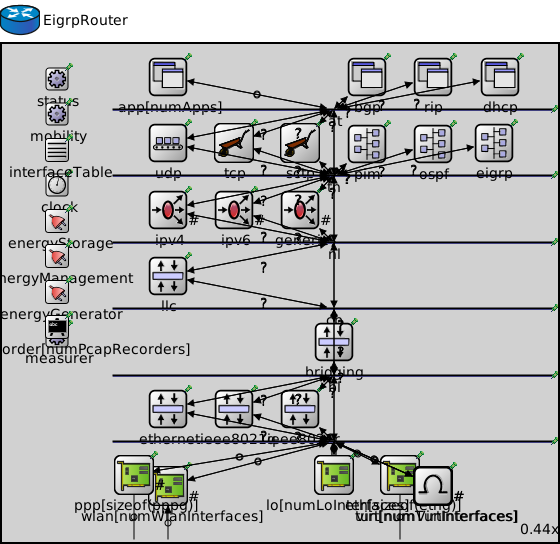
compound moduleA router that uses the Enhanced Interior Gateway Routing Protocol (EIGRP). It extends the standard Router(1,2) module with EIGRP functionality and dual-stack (IPv4/IPv6) support.
EIGRP is an advanced distance-vector routing protocol developed by Cisco Systems. It combines features of both distance-vector and link-state routing protocols, providing fast convergence, loop-free operation, and efficient use of bandwidth and processing resources.
<b>See also:</b> ~OspfRouter, ~RipRouter
Inheritance diagram
The following diagram shows inheritance relationships for this type. Unresolved types are missing from the diagram.
Used in
| Name | Type | Description |
|---|---|---|
| EigrpTestNetwork | network | (no description) |
| EigrpTestNetwork | network | (no description) |
| EigrpTestNetwork | network | (no description) |
| EigrpTestNetwork | network | (no description) |
| EigrpTestNetwork | network | (no description) |
| EigrpTestNetwork | network | (no description) |
| EigrpTestNetwork | network | (no description) |
| EigrpTestNetwork | network | (no description) |
| EigrpTestNetwork | network | (no description) |
Extends
| Name | Type | Description |
|---|---|---|
| Router | compound module |
A network router device with support for multiple routing protocols and network interfaces. Provides the foundation for simulating various types of routers in both wired and wireless networks. |
Parameters
| Name | Type | Default value | Description |
|---|---|---|---|
| displayStringTextFormat | string | "" |
Determines the text that is written on top of the submodule, supports displaying pars, watches, and module-specific information |
| hasStatus | bool | false | |
| hasEnvironment | bool | false | |
| osgModel | string | "" |
3D model for OSG visualization, no 3D model by default |
| osgModelColor | string | "" |
Tint color, no colorization by default |
| canvasImage | string | "" |
Image for canvas visualization, no image by default |
| canvasImageColor | string | "" |
Tint color, no colorization by default |
| recordPcap | bool | false | |
| numPcapRecorders | int | recordPcap ? 1 : 0 | |
| numLoInterfaces | int | 1 | |
| numWlanInterfaces | int | 0 | |
| numEthInterfaces | int | 0 |
Minimum number of Ethernet interfaces |
| numPppInterfaces | int | 0 |
Minimum number of PPP interfaces |
| numTunInterfaces | int | 0 | |
| numVirtInterfaces | int | 0 | |
| fcsMode | string | "declared" | |
| hasIpv4 | bool | true | |
| hasIpv6 | bool | true | |
| hasGn | bool | false | |
| forwarding | bool | true | |
| multicastForwarding | bool | false | |
| hasUdp | bool | hasRip || hasDhcp | |
| hasTcp | bool | hasBgp | |
| hasSctp | bool | false | |
| hasQuic | bool | false | |
| numApps | int | 0 | |
| hasEigrp | bool | true | |
| hasOspf | bool | false | |
| hasRip | bool | false | |
| hasBgp | bool | false | |
| hasPim | bool | false | |
| hasDhcp | bool | false |
Properties
| Name | Value | Description |
|---|---|---|
| class | NodeBase | |
| networkNode | ||
| labels | node | |
| display | i=abstract/router |
Gates
| Name | Direction | Size | Description |
|---|---|---|---|
| radioIn [ ] | input | numWlanInterfaces | |
| pppg [ ] | inout | numPppInterfaces | |
| ethg [ ] | inout | numEthInterfaces |
Unassigned submodule parameters
| Name | Type | Default value | Description |
|---|---|---|---|
| status.displayStringTextFormat | string | "" |
Determines the text that is written on top of the submodule, supports displaying pars, watches, and module-specific information |
| status.initialStatus | string | "UP" |
TODO @signal, @statistic |
| environment.displayStringTextFormat | string | "" |
Determines the text that is written on top of the submodule, supports displaying pars, watches, and module-specific information |
| environment.initStage | int | 0 |
Initialization stage for the setup command |
| environment.globalNamespace | bool | false |
Create new network namespaces under /var/run/netns/ (Linux only) |
| environment.namespace | string | "" |
Name of the host OS network namespace (optional) (Linux only) |
| environment.setupCommand | string | "" |
A host OS system command |
| environment.teardownCommand | string | "" |
A host OS system command |
| pcapRecorder.displayStringTextFormat | string | "rec: %n pks" |
Determines the text that is written on top of the submodule, supports displaying pars, watches, and module-specific information |
| pcapRecorder.verbose | bool | true |
Whether to log packets on the module output |
| pcapRecorder.recordEmptyPackets | bool | true |
Specifies if zero length packets are recorded or not |
| pcapRecorder.enableConvertingPackets | bool | true |
Specifies if converting packets to link type is allowed or not |
| pcapRecorder.pcapFile | string | "" |
The PCAP file to be written, suggested value: pcapFile = "${resultdir}/${configname}-#${runnumber}" + fullpath() + ".pcap" |
| pcapRecorder.fileFormat | string | "pcapng" | |
| pcapRecorder.snaplen | int | 65535 |
Maximum number of bytes to record per packet |
| pcapRecorder.timePrecision | int | 6 |
Time precision in recorded file. pcap supports only 6 (usec) or 9 (nanosec), pcapng supports more values (see 'if_tsresol' option in pcapng file format). |
| pcapRecorder.dumpBadFrames | bool | true |
Enable dump of frames with hasBitError |
| pcapRecorder.moduleNamePatterns | string | "wlan[*] eth[*] ppp[*]" |
Space-separated list of sibling module names to listen on |
| pcapRecorder.sendingSignalNames | string | "transmissionEnded" |
Space-separated list of outbound packet signals to subscribe to |
| pcapRecorder.receivingSignalNames | string | "receptionEnded" |
Space-separated list of inbound packet signals to subscribe to |
| pcapRecorder.dumpProtocols | string | "ethernetmac ppp ieee80211mac" |
Space-separated list of protocol names as defined in the Protocol class |
| pcapRecorder.packetFilter | object | "*" |
Which packets are considered, matches all packets by default |
| pcapRecorder.helpers | string | "" |
Usable PcapRecorder::IHelper helpers for accept packettype and store/convert packet as specified linktype currently available: "inet::AckingMacToEthernetPcapRecorderHelper" |
| pcapRecorder.alwaysFlush | bool | false |
Flush the pcapFile after each write to ensure that all packets are captured in case of a crash |
| interfaceTable.displayStringTextFormat | string | "" |
Determines the text that is written on top of the submodule, supports displaying pars, watches, and module-specific information |
| interfaceTable.displayAddresses | bool | false |
Whether to display IP addresses on links |
| cb.displayStringTextFormat | string | "processed %p pk (%l)" |
Determines the text that is written on top of the submodule, supports displaying pars, watches, and module-specific information |
| cb.interfaceTableModule | string |
Module path to the ~InterfaceTable module |
|
| cb.forwardServiceRegistration | bool | true | |
| cb.forwardProtocolRegistration | bool | true | |
| cb.interfaceMapping | object | {} |
Maps network interface names to connected submodule names (e.g. {"eth0": "bridging"}), overrides automatically learned dispatching; * overrides all learned network interfaces, ? overrides default |
| cb.serviceMapping | object | {} |
Maps protocols to connected submodule names (e.g. {"ethernetmac": "bridging"}), overrides automatically learned dispatching; * overrides all learned services, ? overrides default |
| cb.protocolMapping | object | {} |
Maps protocols to connected submodule names (e.g. {"ipv4": "bridging"}), overrides automatically learned dispatching; * overrides all learned protocols, ? overrides default |
| bl.displayStringTextFormat | string | "processed %p pk (%l)" |
Determines the text that is written on top of the submodule, supports displaying pars, watches, and module-specific information |
| bl.interfaceTableModule | string |
Module path to the ~InterfaceTable module |
|
| bl.forwardServiceRegistration | bool | true | |
| bl.forwardProtocolRegistration | bool | true | |
| bl.interfaceMapping | object | {} |
Maps network interface names to connected submodule names (e.g. {"eth0": "bridging"}), overrides automatically learned dispatching; * overrides all learned network interfaces, ? overrides default |
| bl.serviceMapping | object | {} |
Maps protocols to connected submodule names (e.g. {"ethernetmac": "bridging"}), overrides automatically learned dispatching; * overrides all learned services, ? overrides default |
| bl.protocolMapping | object | {} |
Maps protocols to connected submodule names (e.g. {"ipv4": "bridging"}), overrides automatically learned dispatching; * overrides all learned protocols, ? overrides default |
| li.displayStringTextFormat | string | "processed %p pk (%l)" |
Determines the text that is written on top of the submodule, supports displaying pars, watches, and module-specific information |
| li.interfaceTableModule | string |
Module path to the ~InterfaceTable module |
|
| li.forwardServiceRegistration | bool | true | |
| li.forwardProtocolRegistration | bool | true | |
| li.interfaceMapping | object | {} |
Maps network interface names to connected submodule names (e.g. {"eth0": "bridging"}), overrides automatically learned dispatching; * overrides all learned network interfaces, ? overrides default |
| li.serviceMapping | object | {} |
Maps protocols to connected submodule names (e.g. {"ethernetmac": "bridging"}), overrides automatically learned dispatching; * overrides all learned services, ? overrides default |
| li.protocolMapping | object | {} |
Maps protocols to connected submodule names (e.g. {"ipv4": "bridging"}), overrides automatically learned dispatching; * overrides all learned protocols, ? overrides default |
| eth.bitrate | double | ||
| nl.displayStringTextFormat | string | "processed %p pk (%l)" |
Determines the text that is written on top of the submodule, supports displaying pars, watches, and module-specific information |
| nl.interfaceTableModule | string |
Module path to the ~InterfaceTable module |
|
| nl.forwardServiceRegistration | bool | true | |
| nl.forwardProtocolRegistration | bool | true | |
| nl.interfaceMapping | object | {} |
Maps network interface names to connected submodule names (e.g. {"eth0": "bridging"}), overrides automatically learned dispatching; * overrides all learned network interfaces, ? overrides default |
| nl.serviceMapping | object | {} |
Maps protocols to connected submodule names (e.g. {"ethernetmac": "bridging"}), overrides automatically learned dispatching; * overrides all learned services, ? overrides default |
| nl.protocolMapping | object | {} |
Maps protocols to connected submodule names (e.g. {"ipv4": "bridging"}), overrides automatically learned dispatching; * overrides all learned protocols, ? overrides default |
| tn.displayStringTextFormat | string | "processed %p pk (%l)" |
Determines the text that is written on top of the submodule, supports displaying pars, watches, and module-specific information |
| tn.interfaceTableModule | string |
Module path to the ~InterfaceTable module |
|
| tn.forwardServiceRegistration | bool | true | |
| tn.forwardProtocolRegistration | bool | true | |
| tn.interfaceMapping | object | {} |
Maps network interface names to connected submodule names (e.g. {"eth0": "bridging"}), overrides automatically learned dispatching; * overrides all learned network interfaces, ? overrides default |
| tn.serviceMapping | object | {} |
Maps protocols to connected submodule names (e.g. {"ethernetmac": "bridging"}), overrides automatically learned dispatching; * overrides all learned services, ? overrides default |
| tn.protocolMapping | object | {} |
Maps protocols to connected submodule names (e.g. {"ipv4": "bridging"}), overrides automatically learned dispatching; * overrides all learned protocols, ? overrides default |
| at.displayStringTextFormat | string | "processed %p pk (%l)" |
Determines the text that is written on top of the submodule, supports displaying pars, watches, and module-specific information |
| at.interfaceTableModule | string |
Module path to the ~InterfaceTable module |
|
| at.forwardServiceRegistration | bool | true | |
| at.forwardProtocolRegistration | bool | true | |
| at.interfaceMapping | object | {} |
Maps network interface names to connected submodule names (e.g. {"eth0": "bridging"}), overrides automatically learned dispatching; * overrides all learned network interfaces, ? overrides default |
| at.serviceMapping | object | {} |
Maps protocols to connected submodule names (e.g. {"ethernetmac": "bridging"}), overrides automatically learned dispatching; * overrides all learned services, ? overrides default |
| at.protocolMapping | object | {} |
Maps protocols to connected submodule names (e.g. {"ipv4": "bridging"}), overrides automatically learned dispatching; * overrides all learned protocols, ? overrides default |
| bgp.interfaceTableModule | string |
The path to the InterfaceTable module |
|
| bgp.routingTableModule | string | ||
| bgp.ospfRoutingModule | string | parent.hasOspf ? "^.ospf" : "" |
Source code
//
// A router that uses the Enhanced Interior Gateway Routing Protocol (EIGRP). It
// extends the standard Router module with EIGRP functionality and dual-stack
// (IPv4/IPv6) support.
//
// EIGRP is an advanced distance-vector routing protocol developed by Cisco Systems.
// It combines features of both distance-vector and link-state routing protocols,
// providing fast convergence, loop-free operation, and efficient use of bandwidth
// and processing resources.
//
// @see ~OspfRouter, ~RipRouter
//
module EigrpRouter extends Router
{
    parameters:
        hasEigrp = true;
        hasIpv6 = default(true);
        *.routingTableModule = default("^.^.ipv4.routingTable");
        *.routingTableModule6 = default("^.^.ipv6.routingTable");
}
File: src/inet/node/eigrp/EigrpRouter.ned
 This documentation is released under the Creative Commons license