Package: inet.clock.model
SettableClock
compound moduleThis module represents a settable (step-able) clock with adjustable oscillator compensation.
Extends ~OscillatorBasedClock with the ability to step the clock time to an explicitly provided value (forward or backward) and to apply a new oscillator-compensation factor. Stepping the clock introduces a discontinuity in the clock-time mapping. Overdue events (whose target time becomes < now after the step) can be handled in three ways:
- execute : run overdue events immediately (in order)
- skip : drop/cancel overdue events
- error : terminate simulation and report an error
The clock time can be set from C++ or by a clock servo module or by a time synchronization protocol or using a <set-clock module="..." time="..."/> command in a ScenarioManager script.
<b>See also:</b> ~IClockServo, ~ScenarioManager
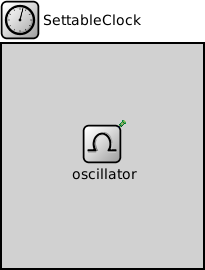
Usage diagram
The following diagram shows usage relationships between types. Unresolved types are missing from the diagram.
Inheritance diagram
The following diagram shows inheritance relationships for this type. Unresolved types are missing from the diagram.
Extends
| Name | Type | Description |
|---|---|---|
| OscillatorBasedClock | compound module |
Oscillator-driven clock. |
Parameters
| Name | Type | Default value | Description |
|---|---|---|---|
| displayStringTextFormat | string | "%t (%c)" |
Determines the text that is written on top of the submodule, supports displaying pars, watches, and module-specific information |
| referenceClock | string | "" |
Full path of the reference clock |
| clockTimeChangeEventSchedulingPriority | int | 0 |
Specifies the scheduling priority of the clock time changed event |
| emitClockTimeInterval | double | 0s |
A non-zero value means the clock time will be emitted periodically |
| oscillatorModule | string | ".oscillator" | |
| initialClockTime | double | 0s |
Clock time at the simulation time when the module is initialized |
| roundingMode | string | "up" |
When scheduling to a clock time or with a clock delay this clock uses rounding with respect to the nominal tick length |
| useFutureEventSet | bool | true |
true: schedule in FES; false: internal list (requires oscillator signals) |
| clockGranularity | double | 0s |
Scheduling grid G; 0s ⇒ use oscillator nominal tick length |
| initialOscillatorCompensation | double | 0ppm | |
| defaultOverdueClockEventHandlingMode | string | "execute" |
Properties
| Name | Value | Description |
|---|---|---|
| class | SettableClock | |
| display | i=block/timer |
Signals
| Name | Type | Unit | Description |
|---|---|---|---|
| oscillatorCompensationChanged | double |
Statistics
| Name | Title | Source | Record | Unit | Interpolation Mode | Description |
|---|---|---|---|---|---|---|
| oscillatorCompensationChanged | oscillator compensation | vector | ppm | sample-hold |
Source code
//
// This module represents a settable (step-able) clock with adjustable oscillator compensation.
//
// Extends ~OscillatorBasedClock with the ability to step the clock time to an explicitly provided value (forward or
// backward) and to apply a new oscillator-compensation factor. Stepping the clock introduces a discontinuity in the
// clock-time mapping. Overdue events (whose target time becomes < now after the step) can be handled in three ways:
//  - execute : run overdue events immediately (in order)
//  - skip    : drop/cancel overdue events
//  - error   : terminate simulation and report an error
//
// The clock time can be set from C++ or by a clock servo module or by a time synchronization protocol or using a
// <set-clock module="..." time="..."/> command in a `ScenarioManager` script.
//
// @see ~IClockServo, ~ScenarioManager
//
module SettableClock extends OscillatorBasedClock
{
    parameters:
        double initialOscillatorCompensation @unit(ppm) = default(0ppm);
        string defaultOverdueClockEventHandlingMode @enum("execute","skip","error") = default("execute");
        @class(SettableClock);
        @signal[oscillatorCompensationChanged](type=double);
        @statistic[oscillatorCompensationChanged](title="oscillator compensation"; record=vector; interpolationmode=sample-hold; unit=ppm);
    submodules:
        underlyingClock: <default("OscillatorBasedClock")> like IClock if typename != "" {
            parameters:
                oscillator.typename = "";
                oscillatorModule = default("^.oscillator");
                useFutureEventSet = default(parent.useFutureEventSet);
                @display("p=100,200");
        }
}
File: src/inet/clock/model/SettableClock.ned
 This documentation is released under the Creative Commons license