Package: inet.clock.model
OscillatorBasedClock
compound moduleOscillator-driven clock.
Summary
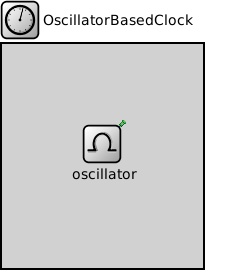
A clock that derives its time from an underlying ~IOscillator. The oscillator may drift, i.e., its actual tick spacing can vary over simulation time. The clock maps simulation time to clock time by counting oscillator ticks and using the *nominal* tick length as the tick-to-time conversion. No per-tick events are generated.
Semantics
- Let the oscillator expose: N(Δt): ticks in (0, Δt] from its computation origin, I(n) : minimal Δt ≥ 0 with N(Δt) ≥ n.
- The clock maintains a (cos, coc) origin pair (simulation/clock time). From there, simulation time to clock time and clock time to simulation time conversions are computed using N/I and the nominal tick length.
- Absolute (“at clock time”) vs. relative (“after clock duration”) scheduling behave as specified by ~IClock(1,2). Oscillator rate/origin changes affect the arrival simulation time accordingly; absolute steps shift “at” events, relative delays remain anchored but follow the new rate going forward.
Granularity & rounding
- The clock quantizes requested targets to a grid G before scheduling, where G := (clockGranularity != 0s) ? clockGranularity : nominalTickLength(osc).
- roundingMode applies to both absolute targets and relative delays: * down : floor to grid G * up : ceil to grid G * closer : nearest grid point (tie-breaking as implemented; typically half-up) * none : no rounding (requested value used as is)
- Use a smaller clockGranularity than the nominal tick length if you need to represent fine compensation steps more accurately.
Event management
- useFutureEventSet = true: Events are scheduled directly into the OMNeT++ FES.
- useFutureEventSet = false: The clock maintains its own pending list and executes events when the oscillator advances; this requires the oscillator to emit its tick/state signals.
Display string format directives
-s : origin simulation time (cos) -c : origin clock time (coc)
Usage diagram
The following diagram shows usage relationships between types. Unresolved types are missing from the diagram.
Inheritance diagram
The following diagram shows inheritance relationships for this type. Unresolved types are missing from the diagram.
Used in
| Name | Type | Description |
|---|---|---|
| ClockExample | network | (no description) |
Known subclasses
| Name | Type | Description |
|---|---|---|
| SettableClock | compound module |
This module represents a settable (step-able) clock with adjustable oscillator compensation. |
Extends
| Name | Type | Description |
|---|---|---|
| ClockBase | compound module |
Base module for clocks. |
Parameters
| Name | Type | Default value | Description |
|---|---|---|---|
| displayStringTextFormat | string | "%t (%c)" |
Determines the text that is written on top of the submodule, supports displaying pars, watches, and module-specific information |
| referenceClock | string | "" |
Full path of the reference clock |
| clockTimeChangeEventSchedulingPriority | int | 0 |
Specifies the scheduling priority of the clock time changed event |
| emitClockTimeInterval | double | 0s |
A non-zero value means the clock time will be emitted periodically |
| oscillatorModule | string | ".oscillator" | |
| initialClockTime | double | 0s |
Clock time at the simulation time when the module is initialized |
| roundingMode | string | "up" |
When scheduling to a clock time or with a clock delay this clock uses rounding with respect to the nominal tick length |
| useFutureEventSet | bool | true |
true: schedule in FES; false: internal list (requires oscillator signals) |
| clockGranularity | double | 0s |
Scheduling grid G; 0s ⇒ use oscillator nominal tick length |
Properties
| Name | Value | Description |
|---|---|---|
| class | OscillatorBasedClock | |
| display | i=block/timer |
Signals
| Name | Type | Unit | Description |
|---|---|---|---|
| timeChanged | simtime_t |
Statistics
| Name | Title | Source | Record | Unit | Interpolation Mode | Description |
|---|---|---|---|---|---|---|
| timeChanged | Clock time | localSignal(timeChanged) | vector | s | linear |
Source code
//
// Oscillator-driven clock.
//
// Summary
// -------
// A clock that derives its time from an underlying ~IOscillator. The oscillator may drift, i.e., its actual tick
// spacing can vary over simulation time. The clock maps simulation time to clock time by counting oscillator ticks
// and using the *nominal* tick length as the tick-to-time conversion. No per-tick events are generated.
//
// Semantics
// ---------
// - Let the oscillator expose:
//     N(Δt): ticks in (0, Δt] from its computation origin,
//     I(n) : minimal Δt ≥ 0 with N(Δt) ≥ n.
// - The clock maintains a (cos, coc) origin pair (simulation/clock time). From there, simulation time to clock time
//   and clock time to simulation time conversions are computed using N/I and the nominal tick length.
// - Absolute (“at clock time”) vs. relative (“after clock duration”) scheduling behave as specified by ~IClock.
//   Oscillator rate/origin changes affect the arrival simulation time accordingly; absolute steps shift “at” events,
//   relative delays remain anchored but follow the new rate going forward.
//
// Granularity & rounding
// ----------------------
// - The clock quantizes requested targets to a grid G before scheduling, where
//     G := (clockGranularity != 0s) ? clockGranularity : nominalTickLength(osc).
// - roundingMode applies to both absolute targets and relative delays:
//     * down   : floor to grid G
//     * up     : ceil  to grid G
//     * closer : nearest grid point (tie-breaking as implemented; typically half-up)
//     * none   : no rounding (requested value used as is)
// - Use a smaller clockGranularity than the nominal tick length if you need to represent fine compensation steps more accurately.
//
// Event management
// ----------------
// - useFutureEventSet = true:
//     Events are scheduled directly into the OMNeT++ FES.
// - useFutureEventSet = false:
//     The clock maintains its own pending list and executes events when the oscillator advances; this requires the
//     oscillator to emit its tick/state signals.
//
// Display string format directives
// --------------------------------
//  -s : origin simulation time (cos)
//  -c : origin clock time (coc)
//
module OscillatorBasedClock extends ClockBase like IClock
{
    parameters:
        displayStringTextFormat = default("%t (%c)"); // Determines the text that is written on top of the submodule
        string oscillatorModule = default(".oscillator");
        double initialClockTime @unit(s) = default(0s); // Clock time at the simulation time when the module is initialized
        string roundingMode @enum("down","up","closer","none") = default("up"); // When scheduling to a clock time or with a clock delay this clock uses rounding with respect to the nominal tick length
        bool useFutureEventSet = default(true);        // true: schedule in FES; false: internal list (requires oscillator signals)
        double clockGranularity @unit(s) = default(0s);// Scheduling grid G; 0s ⇒ use oscillator nominal tick length
        @class(OscillatorBasedClock);
    submodules:
        oscillator: <default("ConstantDriftOscillator")> like IOscillator if typename != "" {
            @display("p=100,100");
            emitNumTicksSignal = default(!parent.useFutureEventSet); // needed when not using FES
        }
}
File: src/inet/clock/model/OscillatorBasedClock.ned
 This documentation is released under the Creative Commons license