Package: inet.node.tsn
TsnDevice
compound moduleAn end device with Time-Sensitive Networking (TSN) capabilities. It extends the StandardHost with various TSN features defined in the IEEE 802.1 standards suite for deterministic, low-latency communication over Ethernet networks.
This module represents a hardware end device (such as a sensor, controller, or actuator) that participates in a TSN network. It supports a comprehensive set of TSN features, all of which are optional and can be enabled or disabled individually. The device can be configured with time synchronization, traffic filtering and shaping, stream redundancy, and frame preemption capabilities.
Key features:
- IEEE 802.1AS time synchronization as a slave node
- IEEE 802.1Qci per-stream filtering and policing for both ingress and egress traffic
- IEEE 802.1Q traffic shaping
- IEEE 802.1CB frame replication and elimination for seamless redundancy
- IEEE 802.1Qbu frame preemption for reduced latency of critical traffic
- Cut-through switching support for minimal latency
<b>See also:</b> ~TsnSwitch, ~TsnClock
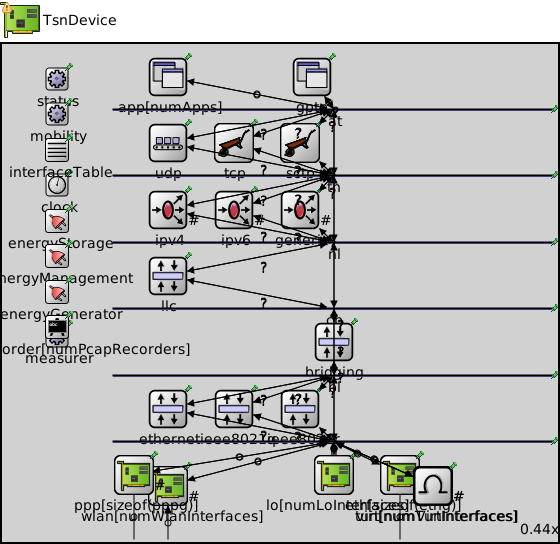
Usage diagram
The following diagram shows usage relationships between types. Unresolved types are missing from the diagram.
Inheritance diagram
The following diagram shows inheritance relationships for this type. Unresolved types are missing from the diagram.
Used in
| Name | Type | Description |
|---|---|---|
| AsynchronousShaperValidation | network | (no description) |
| AsynchronousShaperValidation | network | (no description) |
| AutomaticFailureProtectionShowcase | network | (no description) |
| AutomaticFailureProtectionShowcase | network | (no description) |
| AutomaticMultipathConfigurationShowcase | network | (no description) |
| CreditBasedShaperValidation | network | (no description) |
| CutthroughSwitchingShowcase | network | (no description) |
| FrameReplicationValidation | network | (no description) |
| FrerAndTasShowcase | network | (no description) |
| GptpAndTasShowcase | network | (no description) |
| ManualConfigurationShowcase | network | (no description) |
| OneMasterClockGptpShowcase | network | (no description) |
| TimeAwareShapingShowcaseNetwork | network | (no description) |
| TwoMasterClocksRingGptpShowcase | network | (no description) |
| TwoMasterClocksTreeGptpShowcase | network | (no description) |
Extends
| Name | Type | Description |
|---|---|---|
| StandardHost | compound module |
A comprehensive model of an IPv4/IPv6 host that provides a complete network stack with configurable application, transport, network, and link layers. It supports multiple network interfaces, protocols, and applications that can be customized through parameters. |
Parameters
| Name | Type | Default value | Description |
|---|---|---|---|
| displayStringTextFormat | string | "" |
Determines the text that is written on top of the submodule, supports displaying pars, watches, and module-specific information |
| hasStatus | bool | false | |
| hasEnvironment | bool | false | |
| osgModel | string | "" |
3D model for OSG visualization, no 3D model by default |
| osgModelColor | string | "" |
Tint color, no colorization by default |
| canvasImage | string | "" |
Image for canvas visualization, no image by default |
| canvasImageColor | string | "" |
Tint color, no colorization by default |
| recordPcap | bool | false | |
| numPcapRecorders | int | recordPcap ? 1 : 0 | |
| numLoInterfaces | int | 1 | |
| numWlanInterfaces | int | 0 | |
| numEthInterfaces | int | 0 |
Minimum number of Ethernet interfaces |
| numPppInterfaces | int | 0 |
Minimum number of PPP interfaces |
| numTunInterfaces | int | 0 | |
| numVirtInterfaces | int | 0 | |
| fcsMode | string | "declared" | |
| hasIpv4 | bool | true | |
| hasIpv6 | bool | false | |
| hasGn | bool | false | |
| forwarding | bool | false | |
| multicastForwarding | bool | false | |
| hasUdp | bool | firstAvailableOrEmpty("Udp") != "" | |
| hasTcp | bool | firstAvailableOrEmpty("Tcp", "TcpLwip", "TcpNsc") != "" | |
| hasSctp | bool | false | |
| hasQuic | bool | false | |
| numApps | int | 0 | |
| hasTimeSynchronization | bool | false |
Enable IEEE 802.1 AS time synchronization |
| hasIngressTrafficFiltering | bool | false |
Enable IEEE 802.1 Qci ingress per-stream filtering |
| hasEgressTrafficFiltering | bool | false |
Enable IEEE 802.1 Qci egress per-stream filtering |
| hasEgressTrafficShaping | bool | false |
Enable IEEE 802.1 egress traffic shaping (credit based shaping, time-aware shaping, asynchronous shaping) |
| hasStreamRedundancy | bool | false |
Enable IEEE 802.1 CB frame replication and elimination |
| hasIncomingStreams | bool | false |
Enable IEEE 802.1 stream decoding |
| hasOutgoingStreams | bool | false |
Enable IEEE 802.1 stream identification and stream encoding |
| hasFramePreemption | bool | false |
Enable IEEE 802.1 Qbu frame preemption |
| hasCutthroughSwitching | bool | false |
Enable cut-through switching support |
| hasBridging | bool | hasIncomingStreams || hasOutgoingStreams || hasStreamRedundancy || hasIngressTrafficFiltering || hasEgressTrafficFiltering |
Properties
| Name | Value | Description |
|---|---|---|
| class | NodeBase | |
| networkNode | ||
| labels | node | |
| display | i=device/card |
Change icon to emphasize hardware device |
Gates
| Name | Direction | Size | Description |
|---|---|---|---|
| radioIn [ ] | input | numWlanInterfaces | |
| pppg [ ] | inout | numPppInterfaces | |
| ethg [ ] | inout | numEthInterfaces |
Unassigned submodule parameters
| Name | Type | Default value | Description |
|---|---|---|---|
| status.displayStringTextFormat | string | "" |
Determines the text that is written on top of the submodule, supports displaying pars, watches, and module-specific information |
| status.initialStatus | string | "UP" |
TODO @signal, @statistic |
| environment.displayStringTextFormat | string | "" |
Determines the text that is written on top of the submodule, supports displaying pars, watches, and module-specific information |
| environment.initStage | int | 0 |
Initialization stage for the setup command |
| environment.globalNamespace | bool | false |
Create new network namespaces under /var/run/netns/ (Linux only) |
| environment.namespace | string | "" |
Name of the host OS network namespace (optional) (Linux only) |
| environment.setupCommand | string | "" |
A host OS system command |
| environment.teardownCommand | string | "" |
A host OS system command |
| pcapRecorder.displayStringTextFormat | string | "rec: %n pks" |
Determines the text that is written on top of the submodule, supports displaying pars, watches, and module-specific information |
| pcapRecorder.verbose | bool | true |
Whether to log packets on the module output |
| pcapRecorder.recordEmptyPackets | bool | true |
Specifies if zero length packets are recorded or not |
| pcapRecorder.enableConvertingPackets | bool | true |
Specifies if converting packets to link type is allowed or not |
| pcapRecorder.pcapFile | string | "" |
The PCAP file to be written, suggested value: pcapFile = "${resultdir}/${configname}-#${runnumber}" + fullpath() + ".pcap" |
| pcapRecorder.fileFormat | string | "pcapng" | |
| pcapRecorder.snaplen | int | 65535 |
Maximum number of bytes to record per packet |
| pcapRecorder.timePrecision | int | 6 |
Time precision in recorded file. pcap supports only 6 (usec) or 9 (nanosec), pcapng supports more values (see 'if_tsresol' option in pcapng file format). |
| pcapRecorder.dumpBadFrames | bool | true |
Enable dump of frames with hasBitError |
| pcapRecorder.moduleNamePatterns | string | "wlan[*] eth[*] ppp[*]" |
Space-separated list of sibling module names to listen on |
| pcapRecorder.sendingSignalNames | string | "transmissionEnded" |
Space-separated list of outbound packet signals to subscribe to |
| pcapRecorder.receivingSignalNames | string | "receptionEnded" |
Space-separated list of inbound packet signals to subscribe to |
| pcapRecorder.dumpProtocols | string | "ethernetmac ppp ieee80211mac" |
Space-separated list of protocol names as defined in the Protocol class |
| pcapRecorder.packetFilter | object | "*" |
Which packets are considered, matches all packets by default |
| pcapRecorder.helpers | string | "" |
Usable PcapRecorder::IHelper helpers for accept packettype and store/convert packet as specified linktype currently available: "inet::AckingMacToEthernetPcapRecorderHelper" |
| pcapRecorder.alwaysFlush | bool | false |
Flush the pcapFile after each write to ensure that all packets are captured in case of a crash |
| interfaceTable.displayStringTextFormat | string | "" |
Determines the text that is written on top of the submodule, supports displaying pars, watches, and module-specific information |
| interfaceTable.displayAddresses | bool | false |
Whether to display IP addresses on links |
| cb.displayStringTextFormat | string | "processed %p pk (%l)" |
Determines the text that is written on top of the submodule, supports displaying pars, watches, and module-specific information |
| cb.interfaceTableModule | string |
Module path to the ~InterfaceTable module |
|
| cb.forwardServiceRegistration | bool | true | |
| cb.forwardProtocolRegistration | bool | true | |
| cb.interfaceMapping | object | {} |
Maps network interface names to connected submodule names (e.g. {"eth0": "bridging"}), overrides automatically learned dispatching; * overrides all learned network interfaces, ? overrides default |
| cb.serviceMapping | object | {} |
Maps protocols to connected submodule names (e.g. {"ethernetmac": "bridging"}), overrides automatically learned dispatching; * overrides all learned services, ? overrides default |
| cb.protocolMapping | object | {} |
Maps protocols to connected submodule names (e.g. {"ipv4": "bridging"}), overrides automatically learned dispatching; * overrides all learned protocols, ? overrides default |
| bl.displayStringTextFormat | string | "processed %p pk (%l)" |
Determines the text that is written on top of the submodule, supports displaying pars, watches, and module-specific information |
| bl.interfaceTableModule | string |
Module path to the ~InterfaceTable module |
|
| bl.forwardServiceRegistration | bool | true | |
| bl.forwardProtocolRegistration | bool | true | |
| bl.interfaceMapping | object | {} |
Maps network interface names to connected submodule names (e.g. {"eth0": "bridging"}), overrides automatically learned dispatching; * overrides all learned network interfaces, ? overrides default |
| bl.serviceMapping | object | {} |
Maps protocols to connected submodule names (e.g. {"ethernetmac": "bridging"}), overrides automatically learned dispatching; * overrides all learned services, ? overrides default |
| bl.protocolMapping | object | {} |
Maps protocols to connected submodule names (e.g. {"ipv4": "bridging"}), overrides automatically learned dispatching; * overrides all learned protocols, ? overrides default |
| li.displayStringTextFormat | string | "processed %p pk (%l)" |
Determines the text that is written on top of the submodule, supports displaying pars, watches, and module-specific information |
| li.interfaceTableModule | string |
Module path to the ~InterfaceTable module |
|
| li.forwardServiceRegistration | bool | true | |
| li.forwardProtocolRegistration | bool | true | |
| li.interfaceMapping | object | {} |
Maps network interface names to connected submodule names (e.g. {"eth0": "bridging"}), overrides automatically learned dispatching; * overrides all learned network interfaces, ? overrides default |
| li.serviceMapping | object | {} |
Maps protocols to connected submodule names (e.g. {"ethernetmac": "bridging"}), overrides automatically learned dispatching; * overrides all learned services, ? overrides default |
| li.protocolMapping | object | {} |
Maps protocols to connected submodule names (e.g. {"ipv4": "bridging"}), overrides automatically learned dispatching; * overrides all learned protocols, ? overrides default |
| eth.bitrate | double | ||
| nl.displayStringTextFormat | string | "processed %p pk (%l)" |
Determines the text that is written on top of the submodule, supports displaying pars, watches, and module-specific information |
| nl.interfaceTableModule | string |
Module path to the ~InterfaceTable module |
|
| nl.forwardServiceRegistration | bool | true | |
| nl.forwardProtocolRegistration | bool | true | |
| nl.interfaceMapping | object | {} |
Maps network interface names to connected submodule names (e.g. {"eth0": "bridging"}), overrides automatically learned dispatching; * overrides all learned network interfaces, ? overrides default |
| nl.serviceMapping | object | {} |
Maps protocols to connected submodule names (e.g. {"ethernetmac": "bridging"}), overrides automatically learned dispatching; * overrides all learned services, ? overrides default |
| nl.protocolMapping | object | {} |
Maps protocols to connected submodule names (e.g. {"ipv4": "bridging"}), overrides automatically learned dispatching; * overrides all learned protocols, ? overrides default |
| tn.displayStringTextFormat | string | "processed %p pk (%l)" |
Determines the text that is written on top of the submodule, supports displaying pars, watches, and module-specific information |
| tn.interfaceTableModule | string |
Module path to the ~InterfaceTable module |
|
| tn.forwardServiceRegistration | bool | true | |
| tn.forwardProtocolRegistration | bool | true | |
| tn.interfaceMapping | object | {} |
Maps network interface names to connected submodule names (e.g. {"eth0": "bridging"}), overrides automatically learned dispatching; * overrides all learned network interfaces, ? overrides default |
| tn.serviceMapping | object | {} |
Maps protocols to connected submodule names (e.g. {"ethernetmac": "bridging"}), overrides automatically learned dispatching; * overrides all learned services, ? overrides default |
| tn.protocolMapping | object | {} |
Maps protocols to connected submodule names (e.g. {"ipv4": "bridging"}), overrides automatically learned dispatching; * overrides all learned protocols, ? overrides default |
| at.displayStringTextFormat | string | "processed %p pk (%l)" |
Determines the text that is written on top of the submodule, supports displaying pars, watches, and module-specific information |
| at.interfaceTableModule | string |
Module path to the ~InterfaceTable module |
|
| at.forwardServiceRegistration | bool | true | |
| at.forwardProtocolRegistration | bool | true | |
| at.interfaceMapping | object | {} |
Maps network interface names to connected submodule names (e.g. {"eth0": "bridging"}), overrides automatically learned dispatching; * overrides all learned network interfaces, ? overrides default |
| at.serviceMapping | object | {} |
Maps protocols to connected submodule names (e.g. {"ethernetmac": "bridging"}), overrides automatically learned dispatching; * overrides all learned services, ? overrides default |
| at.protocolMapping | object | {} |
Maps protocols to connected submodule names (e.g. {"ipv4": "bridging"}), overrides automatically learned dispatching; * overrides all learned protocols, ? overrides default |
Source code
//
// An end device with Time-Sensitive Networking (TSN) capabilities. It extends
// the StandardHost with various TSN features defined in the IEEE 802.1
// standards suite for deterministic, low-latency communication over Ethernet
// networks.
//
// This module represents a hardware end device (such as a sensor, controller, or actuator)
// that participates in a TSN network. It supports a comprehensive set of TSN features,
// all of which are optional and can be enabled or disabled individually. The device can
// be configured with time synchronization, traffic filtering and shaping, stream redundancy,
// and frame preemption capabilities.
//
// Key features:
// - IEEE 802.1AS time synchronization as a slave node
// - IEEE 802.1Qci per-stream filtering and policing for both ingress and egress traffic
// - IEEE 802.1Q traffic shaping
// - IEEE 802.1CB frame replication and elimination for seamless redundancy
// - IEEE 802.1Qbu frame preemption for reduced latency of critical traffic
// - Cut-through switching support for minimal latency
//
// @see ~TsnSwitch, ~TsnClock
//
module TsnDevice extends StandardHost
{
    parameters:
        bool hasTimeSynchronization = default(false); // Enable IEEE 802.1 AS time synchronization
        bool hasIngressTrafficFiltering = default(false); // Enable IEEE 802.1 Qci ingress per-stream filtering
        bool hasEgressTrafficFiltering = default(false); // Enable IEEE 802.1 Qci egress per-stream filtering
        bool hasEgressTrafficShaping = default(false); // Enable IEEE 802.1 egress traffic shaping (credit based shaping, time-aware shaping, asynchronous shaping)
        bool hasStreamRedundancy = default(false); // Enable IEEE 802.1 CB frame replication and elimination
        bool hasIncomingStreams = default(false); // Enable IEEE 802.1 stream decoding
        bool hasOutgoingStreams = default(false); // Enable IEEE 802.1 stream identification and stream encoding
        bool hasFramePreemption = default(false); // Enable IEEE 802.1 Qbu frame preemption
        bool hasCutthroughSwitching = default(false); // Enable cut-through switching support
        bool hasBridging = default(hasIncomingStreams || hasOutgoingStreams || hasStreamRedundancy || hasIngressTrafficFiltering || hasEgressTrafficFiltering);
        clock.typename = default(hasTimeSynchronization ? "SettableClock" : ""); // Enable explicit local clock model
        ethernet.typename = default("EthernetLayer"); // Use Ethernet protocol layer outside of network interfaces
        eth[*].typename = default("LayeredEthernetInterface"); // Switch to modular Ethernet interface
        eth[*].macLayer.typename = default(hasFramePreemption ? "EthernetPreemptingMacLayer" : "EthernetMacLayer");
        eth[*].macLayer.queue.typename = default(hasFramePreemption ? "" : (hasEgressTrafficShaping ? "Ieee8021qTimeAwareShaper" : "PacketQueue")); // Use priority queue having multiple subqueues controlled by separate gates
        eth[*].phyLayer.typename = default(hasCutthroughSwitching ? "EthernetStreamingPhyLayer" : (hasFramePreemption ? "EthernetPreemptingPhyLayer" : "EthernetPhyLayer")); // Use packet streaming when cut-through switching is enabled
        bridging.typename = default(hasBridging ? "BridgingLayer" : ""); // Switch to modular bridging
        bridging.interfaceRelay.typename = default(""); // Disable frame relaying
        bridging.streamIdentifier.typename = default(hasOutgoingStreams || hasStreamRedundancy ? "StreamIdentifierLayer" : ""); // Enable stream identification when stream redundancy is enabled
        bridging.streamIdentifier.identifier.hasSequenceNumbering = default(hasStreamRedundancy); // Enable sequence numbering if stream redundancy is enabled
        bridging.streamRelay.typename = default(hasStreamRedundancy ? "StreamRelayLayer" : ""); // Enable stream merging and stream splitting when stream redundancy is enabled
        bridging.streamFilter.typename = default(hasIngressTrafficFiltering || hasEgressTrafficFiltering ? "StreamFilterLayer" : ""); // Enable stream filtering when ingress or egress per-stream filtering is enabled
        bridging.streamFilter.ingress.typename = default(hasIngressTrafficFiltering ? "SimpleIeee8021qFilter" : ""); // Use IEEE 802.1 Qci ingress filter when ingress per-stream filtering is enabled
        bridging.streamFilter.egress.typename = default(hasEgressTrafficFiltering ? "SimpleIeee8021qFilter" : ""); // Use IEEE 802.1 Qci egress filter when egress per-stream filtering is enabled
        bridging.streamCoder.typename = default(hasIncomingStreams || hasOutgoingStreams || hasStreamRedundancy ? "StreamCoderLayer" : ""); // Enable stream encoding/decoding when stream redundancy is enabled
        ieee8021r.typename = default(hasStreamRedundancy ? "Ieee8021rProtocol" : "");
        ieee8021q.typename = default(hasIncomingStreams || hasOutgoingStreams || hasStreamRedundancy ? "Ieee8021qProtocol" : "");
        @display("i=device/card"); // Change icon to emphasize hardware device
    submodules:
        gptp: <default("Gptp")> like IApp if hasTimeSynchronization {
            gptpNodeType = default("SLAVE_NODE");
            slavePort = default("eth0");
            masterPorts = default([]);
            @display("p=700,75");
        }
    connections:
        if hasTimeSynchronization {
            gptp.socketOut --> at.in++;
            at.out++ --> gptp.socketIn;
        }
}
File: src/inet/node/tsn/TsnDevice.ned
 This documentation is released under the Creative Commons license