Package: inet.emulation.common
ExtInterface
compound moduleA base for external network interfaces, network interface modules that connect the simulation to the network stack of the host OS.
Each external interface module is associated with a specific network device on the host OS. The host OS device is identified by the "namespace" and "device" parameters. The "namespace" parameter is optional; when empty, the default namespace is used.
External interfaces can be mentally visualized as composed of an upper and a lower part, one of which is the host OS device and the other is part of the simulation. Therefore, there are two types of external interfaces, which are also reflected in their names:
- In ExtLower interfaces, the lower part is a host OS device, and the upper part is in the simulation. Therefore, an ExtLower interface module has upperLayerIn and upperLayerOut gates for connecting to the upper layers. The device is typically a "veth" (virtual Ethernet) device. (Using real interfaces like "eth0" is also possible, but it needs special care to prevent incoming packets from being replied to by both the simulation and the kernel or other processes on the host OS.)
- In ExtUpper interfaces, the upper part is a host OS device, and the lower part is the simulated one. Therefore, an ExtUpper interface module typically has gates for connecting to the simulated network. The device is typically a "tap" (virtual TUN/TAP) device, which allows the interception of the traffic of the host OS and routing them into the simulation.
ExtLower interfaces are in general useful for connecting simulated apps to a real network, while ExtUpper interfaces are suitable for running a real networked application over a simulated network.
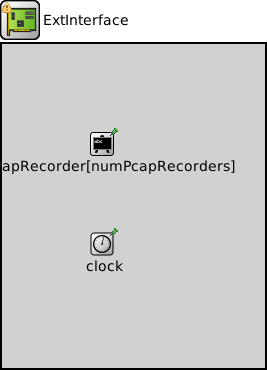
Inheritance diagram
The following diagram shows inheritance relationships for this type. Unresolved types are missing from the diagram.
Known subclasses
| Name | Type | Description |
|---|---|---|
| ExtLowerEthernetInterface | compound module |
Provides an Ethernet network interface suitable for emulation. The lower part of the network interface is realized in the real world using a real Ethernet socket of the host computer which is running the simulation. |
| ExtUpperEthernetInterface | compound module |
Provides an Ethernet network interface suitable for emulation. The upper part of the network interface is realized in the real world using a real TAP device of the host computer which is running the simulation. |
| ExtUpperIeee80211Interface | compound module |
Provides an IEEE 802.11 network interface suitable for emulation. The upper part of the network interface is realized in the real world using a real TAP device of the host computer which is running the simulation. |
Extends
| Name | Type | Description |
|---|---|---|
| NetworkInterface | compound module |
Serves as the base module for all network interfaces. |
Parameters
| Name | Type | Default value | Description |
|---|---|---|---|
| displayStringTextFormat | string | "%a (%i)\n%m" |
Determines the text that is written on top of the submodule, supports displaying pars, watches, and module-specific information |
| recordPcap | bool | false | |
| numPcapRecorders | int | recordPcap ? 1 : 0 | |
| isWireless | bool | false | |
| interfaceTableModule | string |
Module path of the interface table module |
|
| device | string |
Name of the attached OS device (e.g. tap0, veth0, etc.) |
|
| namespace | string | "" |
Name of the OS network namespace (optional) |
| copyConfiguration | string | "" |
Copy interface configuration such as MAC address, IP address, and MTU from/to the external interface. |
| address | string | "auto" | |
| broadcast | bool | true | |
| multicast | bool | true | |
| pointToPoint | bool | false | |
| mtu | int | 4470B |
Properties
| Name | Value | Description |
|---|---|---|
| class | ExtInterface | |
| networkInterface | ||
| lifecycleSupport | ||
| display | i=block/ifcard |
Gates
| Name | Direction | Size | Description |
|---|---|---|---|
| upperLayerIn | input | ||
| upperLayerOut | output |
Signals
| Name | Type | Unit | Description |
|---|---|---|---|
| packetDropped | inet::Packet |
Statistics
| Name | Title | Source | Record | Unit | Interpolation Mode | Description |
|---|---|---|---|---|---|---|
| packetDropInterfaceDown | packet drops: interface down | packetDropReasonIsInterfaceDown(packetDropped) | count, sum(packetBytes), vector(packetBytes) | none | ||
| packetDropNoCarrier | packet drops: no carrier | packetDropReasonIsNoCarrier(packetDropped) | count, sum(packetBytes), vector(packetBytes) | none |
Unassigned submodule parameters
| Name | Type | Default value | Description |
|---|---|---|---|
| pcapRecorder.displayStringTextFormat | string | "rec: %n pks" |
Determines the text that is written on top of the submodule, supports displaying pars, watches, and module-specific information |
| pcapRecorder.verbose | bool | true |
Whether to log packets on the module output |
| pcapRecorder.recordEmptyPackets | bool | true |
Specifies if zero length packets are recorded or not |
| pcapRecorder.enableConvertingPackets | bool | true |
Specifies if converting packets to link type is allowed or not |
| pcapRecorder.pcapFile | string | "" |
The PCAP file to be written, suggested value: pcapFile = "${resultdir}/${configname}-#${runnumber}" + fullpath() + ".pcap" |
| pcapRecorder.fileFormat | string | "pcapng" | |
| pcapRecorder.snaplen | int | 65535 |
Maximum number of bytes to record per packet |
| pcapRecorder.timePrecision | int | 6 |
Time precision in recorded file. pcap supports only 6 (usec) or 9 (nanosec), pcapng supports more values (see 'if_tsresol' option in pcapng file format). |
| pcapRecorder.dumpBadFrames | bool | true |
Enable dump of frames with hasBitError |
| pcapRecorder.sendingSignalNames | string | "transmissionEnded" |
Space-separated list of outbound packet signals to subscribe to |
| pcapRecorder.receivingSignalNames | string | "receptionEnded" |
Space-separated list of inbound packet signals to subscribe to |
| pcapRecorder.dumpProtocols | string | "ethernetmac ppp ieee80211mac" |
Space-separated list of protocol names as defined in the Protocol class |
| pcapRecorder.packetFilter | object | "*" |
Which packets are considered, matches all packets by default |
| pcapRecorder.helpers | string | "" |
Usable PcapRecorder::IHelper helpers for accept packettype and store/convert packet as specified linktype currently available: "inet::AckingMacToEthernetPcapRecorderHelper" |
| pcapRecorder.alwaysFlush | bool | false |
Flush the pcapFile after each write to ensure that all packets are captured in case of a crash |
Source code
//
// A base for external network interfaces, network interface
// modules that connect the simulation to the network stack of the host OS.
//
// Each external interface module is associated with a specific network device
// on the host OS. The host OS device is identified by the "namespace" and
// "device" parameters. The "namespace" parameter is optional; when empty, the
// default namespace is used.
//
// External interfaces can be mentally visualized as composed of an upper and a
// lower part, one of which is the host OS device and the other is part of the
// simulation. Therefore, there are two types of external interfaces, which are
// also reflected in their names:
//
// - In `ExtLower` interfaces, the lower part is a host OS device, and the upper
//   part is in the simulation. Therefore, an `ExtLower` interface module has
//   `upperLayerIn` and `upperLayerOut` gates for connecting to the upper layers.
//   The device is typically a "veth" (virtual Ethernet) device. (Using real
//   interfaces like "eth0" is also possible, but it needs special care to
//   prevent incoming packets from being replied to by both the simulation and the
//   kernel or other processes on the host OS.)
//
// - In `ExtUpper` interfaces, the upper part is a host OS device, and the
//   lower part is the simulated one. Therefore, an `ExtUpper` interface
//   module typically has gates for connecting to the simulated network.
//   The device is typically a "tap" (virtual TUN/TAP) device, which allows
//   the interception of the traffic of the host OS and routing them into the simulation.
//
// `ExtLower` interfaces are in general useful for connecting simulated apps to
// a real network, while `ExtUpper` interfaces are suitable for running a real
// networked application over a simulated network.
//
//
module ExtInterface extends NetworkInterface like IExternalInterface
{
    parameters:
        bool isWireless = default(false);
        string interfaceTableModule; // Module path of the interface table module
        string device; // Name of the attached OS device (e.g. tap0, veth0, etc.)
        string namespace = default("");  // Name of the OS network namespace (optional)
        string copyConfiguration @enum("","copyToExt","copyFromExt") = default(""); // Copy interface configuration such as MAC address, IP address, and MTU from/to the external interface.
        string address @mutable = default("auto");
        bool broadcast = default(true);
        bool multicast = default(true);
        bool pointToPoint = default(false);
        int mtu @unit(B) = default(4470B);
        *.interfaceTableModule = default(absPath(this.interfaceTableModule));
        *.device = default(this.device);
        *.namespace = default(this.namespace);
        @class(ExtInterface);
    gates:
        input upperLayerIn @loose;
        output upperLayerOut @loose;
}
File: src/inet/emulation/common/ExtInterface.ned
 This documentation is released under the Creative Commons license